
For those who have seen the internet and ecommerce evolve, long gone are the days when setting up a simple credit card form at checkout was enough to expect great conversions. Over time, payment performance has increasingly become a question of intelligence, not simply transaction processing.
In its recent Payments Performance Gap report, PYMNTS Intelligence highlights a growing divide between two types of businesses: those that simply process payments and those using orchestration technologies to actively optimize their performance.
For these merchants, the focus shifts from simply displaying a payment solution to designing how transactions are routed, retried, authenticated and approved.
From Intent to Conversion: Reducing the Gap
In modern payment optimization, the underlying objective is straightforward: reduce the gap between customer intent and completed transactions.
For consumer financing, this raises an interesting question:
Could the same optimization logic increasingly apply to the way financing applications are connected to lenders?
Payments Are Becoming a Decisioning Problem
69% of companies using all core orchestration capabilities achieve approval rates above 97%.
For years, payment optimization largely focused on processing transactions reliably and securely. Today, the infrastructure surrounding a payment is becoming considerably more sophisticated.
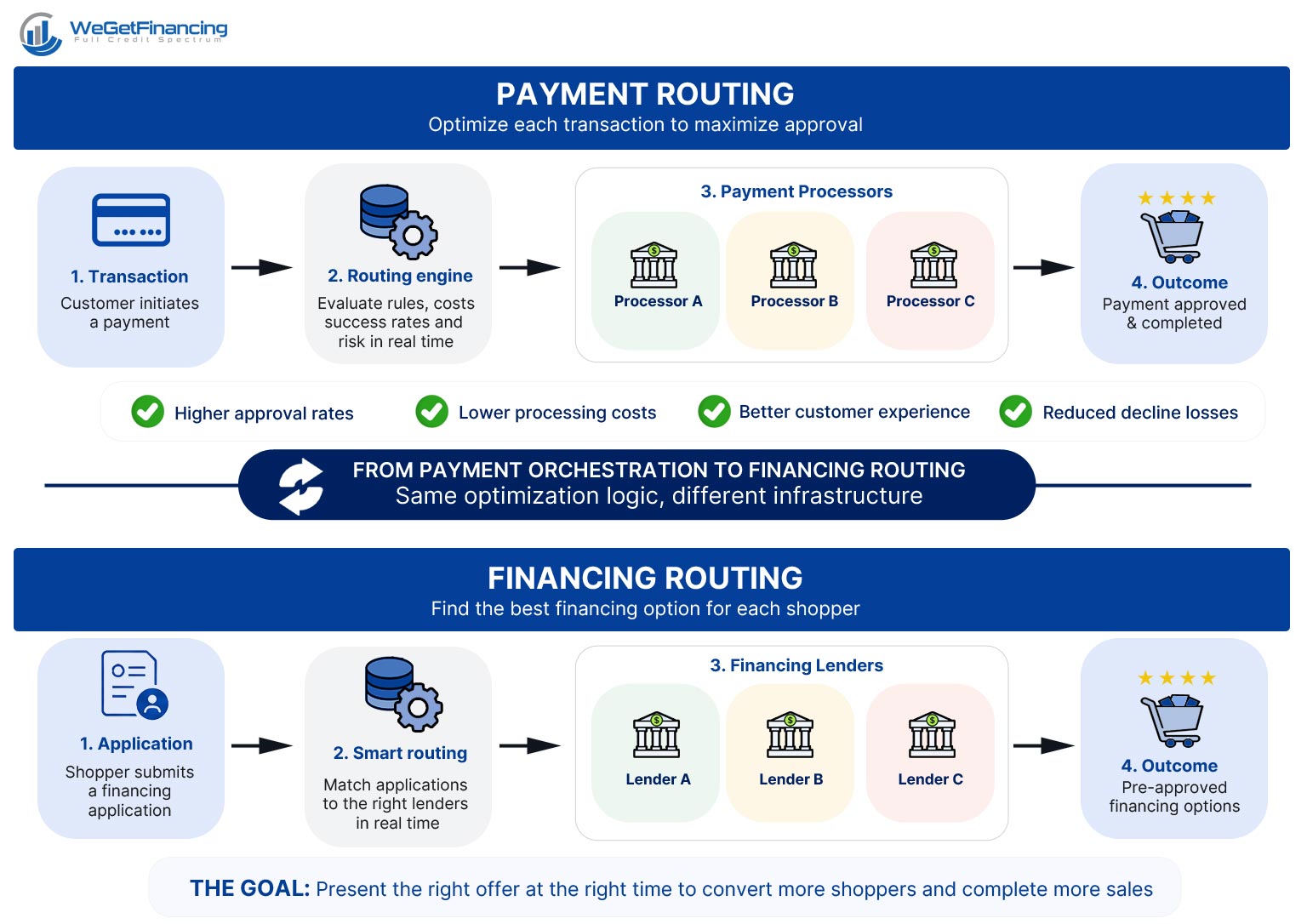
Advanced payment orchestration platforms can evaluate different routes, processors and transaction conditions before determining how a payment should be handled. Routing decisions can also work alongside capabilities such as intelligent retries, token selection and fraud decisioning.
The PYMNTS report suggests that these capabilities can have a significant impact on performance. Among the businesses surveyed, 69% of those using all core orchestration capabilities examined in the study (including routing automation, account updater and network tokens) reported approval rates above 97%, compared with 32% of businesses relying on manual routing.
The important shift is not simply technological. It changes the way merchants think about a failed transaction. Instead of treating every unsuccessful payment as a definitive outcome, payment orchestration introduces another question:
Was there a better way to route the transaction?
Consumer Financing Has Its Own Routing Problem
What lessons can fintech learn from such a profound shift in payment strategy?
Consumer financing operates differently from card payments. Historically, single lenders helped fill the gap left by credit card limitations and consumers’ immediate purchasing capacity. The problem is that lenders have their own underwriting models, credit requirements, loan structures and risk policies.
A declined financing application with one lender therefore does not necessarily mean that the same shopper would receive the same outcome from another. This distinction becomes particularly important for merchants serving a broad range of customer profiles and product price points.
Adding Financing Options Side by Side Is Not Orchestration
Traditionally, retailers seeking greater financing coverage could add several financing providers to their checkout. Each additional provider potentially expands the range of customers the merchant can serve.
It may look great on paper, but more financing options do not automatically create an optimized financing journey. As we discussed in our article on BNPL silent rejection, customers who fail to obtain financing do not necessarily try another provider, contact the merchant or explain why they abandoned their purchase. The lost financing opportunity can simply become a lost sale.
When Conversion Funnels Turn Into Bottlenecks
When a list of single-lender solutions is presented at checkout, the financing funnel can rapidly turn into a bottleneck for the shopper.
It’s a bit like trying to turn the customer into a financing orchestrator. In reality, the customer has no way of knowing in advance which lender is the right match. Asking them to find out by completing application after application is hardly an optimized routing strategy.
At that point, we are getting much closer to casino roulette than payment orchestration: pick a lender, submit an application and see what happens. And the odds of turning a ready-to-purchase shopper into an abandoned cart only increase.
Smart Routing Applied to Financing
A multi-lender gateway approaches the problem differently.
Instead of asking consumers to navigate several independent financing paths, lender matching and routing can connect a single application to financing options across a broader network of lenders.
The technology is different from payment orchestration, but the underlying business question begins to sound familiar:
How can merchants make better use of the options available to convert more valid purchase intent into completed transactions?
Presenting a shopper with financing offers matched to their application anticipates the problem rather than waiting for an underwriting rejection to expose it. The objective is not simply to have more lenders available. It is to make the available network work more intelligently.
From Payment Leakage to Financing Leakage
In its report, PYMNTS also highlights a key driver of payment performance: reducing the gap between customer intent and completed transactions.
Even when a customer wants to complete a purchase, failures occurring between checkout and authorization can cause that transaction to disappear. Consumer financing can create its own version of this problem.
A shopper may select a product, reach checkout and submit a financing application, only to be declined by the financing provider presented to them. The merchant sees a financing rejection. The underlying purchase intent may still be perfectly valid, but the financing path has failed to convert it.
This is what we refer to as financing leakage: purchase intent that disappears because the financing path available to the shopper fails to produce a viable outcome. Our BNPL Leakage Calculator provides a simple way to estimate what that leakage can represent in terms of lost sales and revenue.
More Lenders Are Not the Same as Smarter Routing
Ultimately, the distinction is relatively simple:
- More lenders can create greater potential coverage.
- More financing buttons can also create more complexity.
- Routing helps turn lender coverage into an organized financing path.
- The objective is not to multiply applications, but to improve the chances of connecting each application with an appropriate financing option.
Optionality creates potential coverage. Routing determines how effectively that coverage can be used.
Smart Routing Is Reshaping Payments. Consumer Financing Is Following.
Of course, payment orchestration and multi-lender financing routing are different. They solve different technical problems, operate differently and involve different decision criteria. Nevertheless, the fact that their evolution points toward a similar principle should teach us something.
When several paths are available, simply offering them is not enough. Performance depends on routing each customer toward the right one. That’s where smart architecture and advanced processes can make a real difference.
Payments are already moving rapidly in that direction.
As for consumer financing, orchestration is already taking shape through multi-lender solutions. For merchants, the opportunity is already here: choosing the right technology can improve success rates while delivering a better financing experience to more shoppers.